
Breakfast Bites: Big Tech Meets Big Oil
Google and Tesla report tonight as Brent tests $93, Trump downplays Iran talks, and a 100% tariff threatens the drug supply chain.

Rise and shine everyone
Tonight brings the first wave of mega cap tech earnings, and it lands in the middle of a war that keeps getting bigger, not smaller. Google and Tesla report after the close, and the real question is still whether Wall Street believes the money being poured into AI data centers and factories is actually turning into cash.
Meanwhile, oil keeps climbing as the Iran war grinds into its fifth month and the Houthis threaten to blockade Saudi shipping. Washington also just dropped a 100% tariff threat on generic drugs, which sounds like a domestic manufacturing story until you realize how much of America’s cheap medicine comes from India.
Here is what we are watching today:
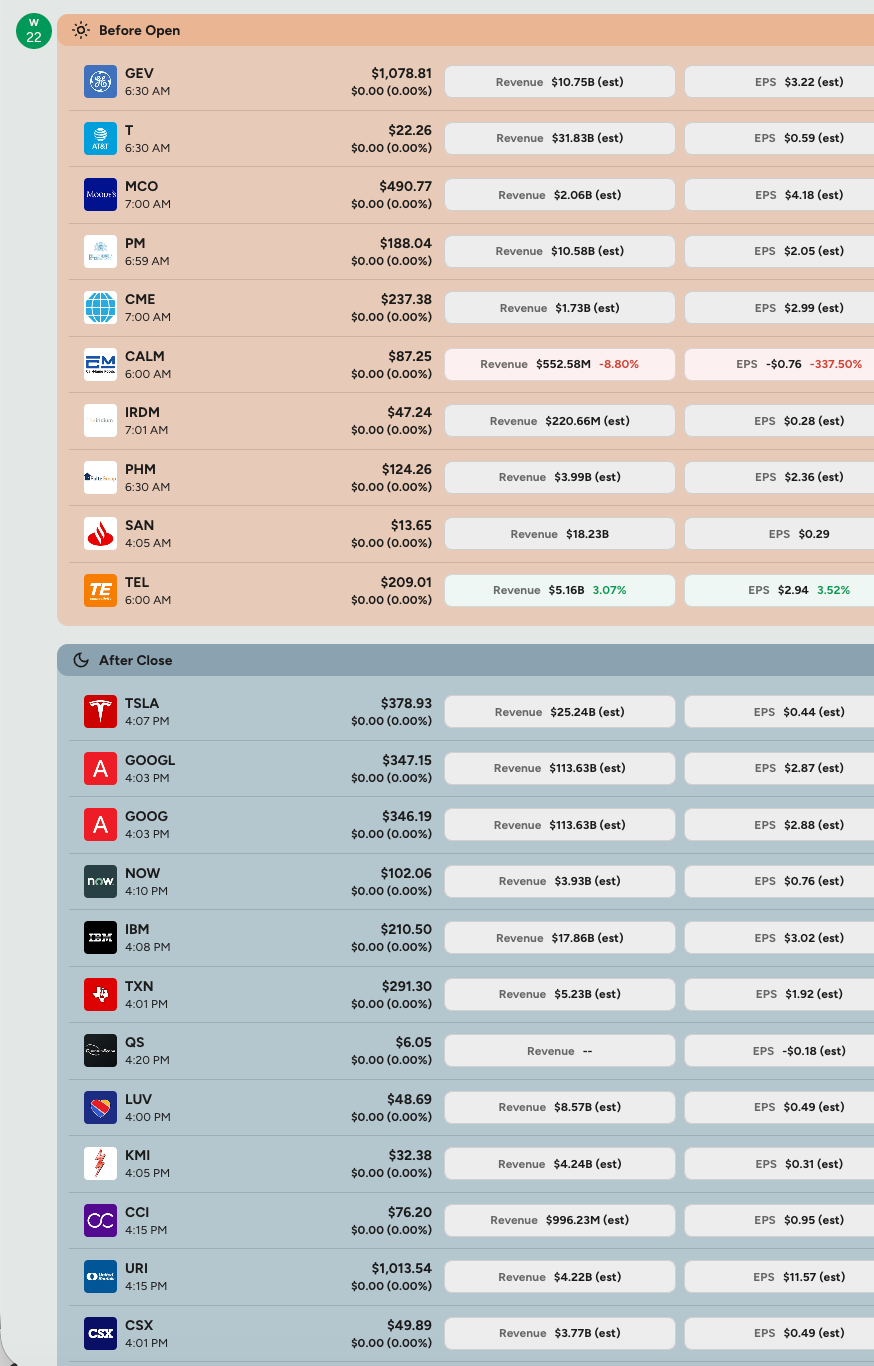
Google, Tesla, Texas Instruments, ServiceNow and IBM report after the close, with 2027 hyperscaler capex the real battleground, not this quarter’s beat
WTI crude pushing toward $100 a barrel as the Houthis threaten a Saudi blockade and mediators push a 10-day ceasefire Iran has yet to accept
A 100% tariff on generic drugs, and the 50% on Canada prior to that - this could broaden the tariff game come Friday, when the temporary US tariffs get replaced
I would stay tactically long the Momentum and Tech barbell into tonight’s prints, but I would flip bearish fast on any hyperscaler capex cut. On oil, $100/bbl on WTI is the level I am watching. Break it, and this stops being a geopolitical story and starts being a demand destruction one.
Morning Macro Briefing
Trump downplayed the odds of near-term talks with Iran on Tuesday, telling reporters Tehran wants to meet only once “they’re ready to meet in a meaningful way.” He also repeated his threat to strike Pickaxe Mountain, the Iranian site the US and Israel suspect is a nuclear facility. Combine that with the Houthis’ threat to blockade Saudi ports and you have a war that is expanding its target list rather than winding down.
Defense Secretary Pete Hegseth told the Senate on Tuesday that the war has cost the US $37.5 billion so far, up from a $29 billion estimate given in May. He is also asking for another $67 billion in supplemental defense funding, part of an $87.6 billion request that will need to be financed somehow. That is a Treasury supply story as much as a defense story, and it is one reason I would expect the long end of the curve to stay under pressure even if oil cools off.
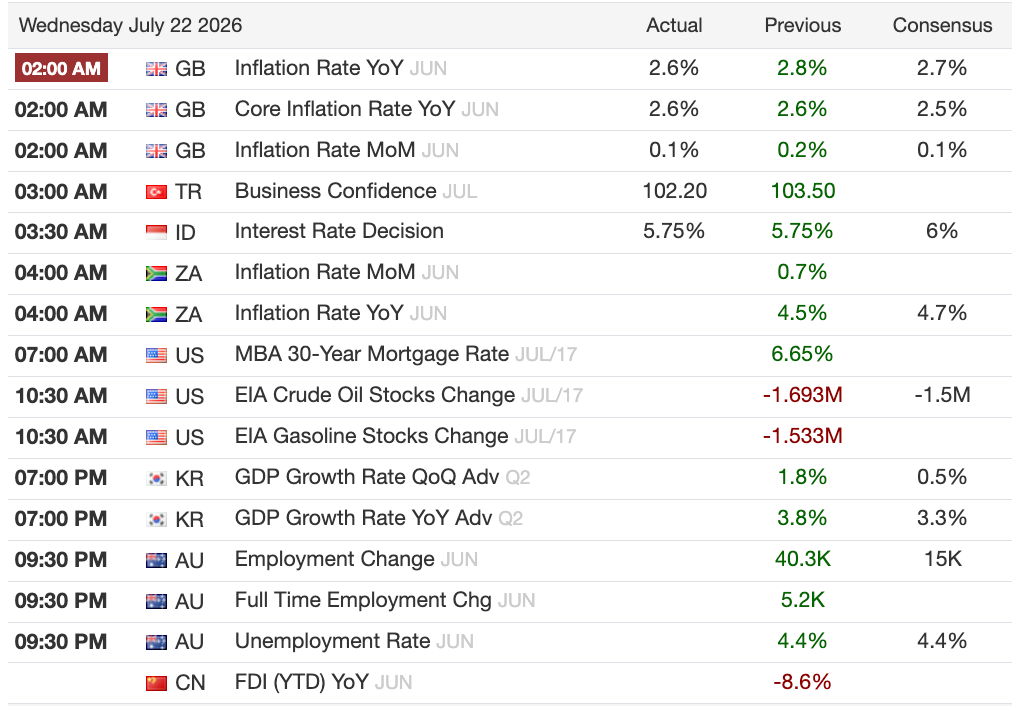
UK CPI cooled more than expected in June, easing to 2.6% from 2.8% in May on falling diesel and petrol prices, while core CPI held at 2.6%, still a touch above consensus. That mix, a soft headline next to sticky core, is exactly the kind of print that lets the Bank of England lean dovish without fully committing to it, so any sharp move in gilts or sterling off the headline alone is likely a fade.
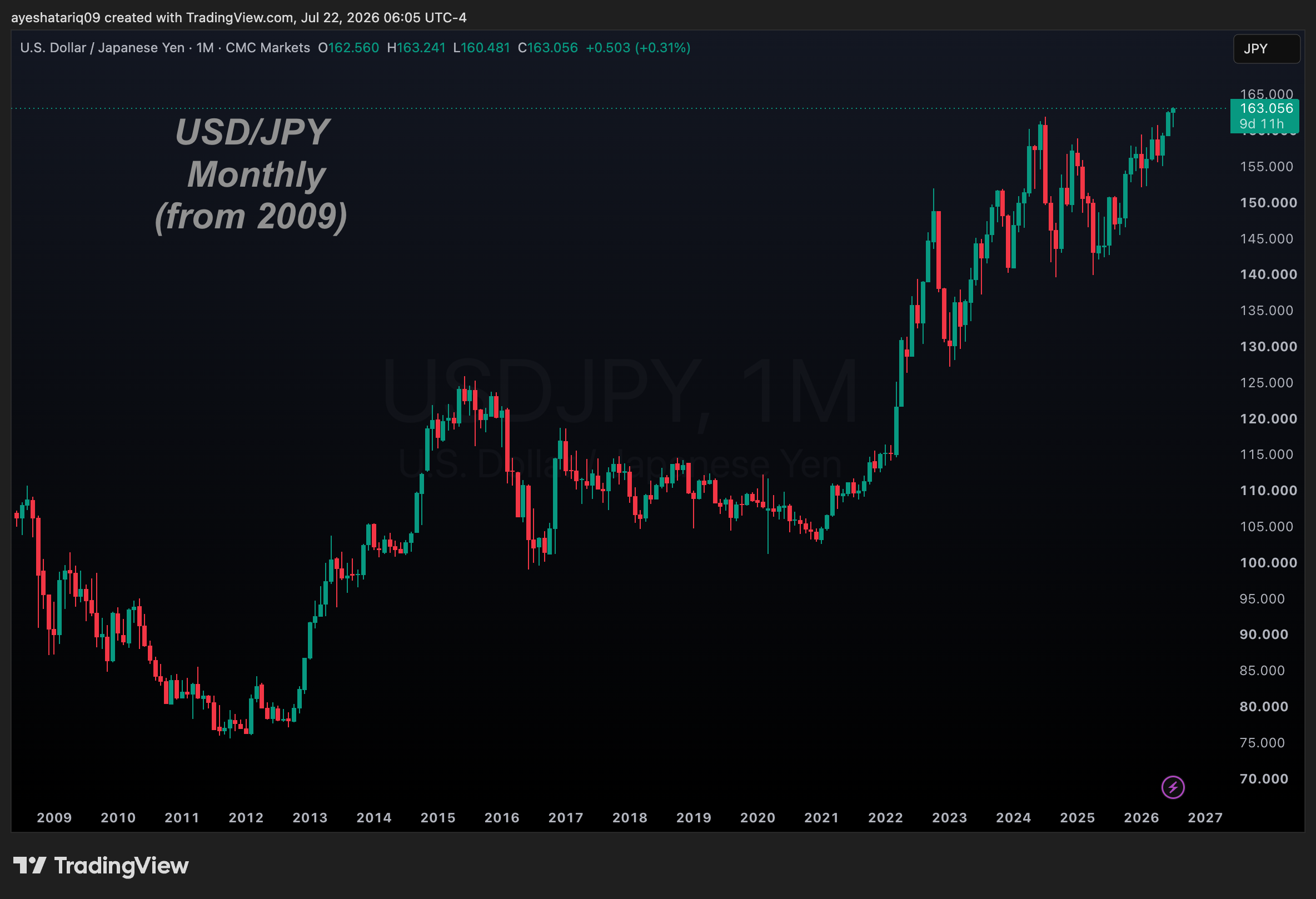
The yen fell past 163 to the dollar on Tuesday, its weakest level in 40 years. Japan’s June trade deficit widened too, as the weak currency and higher Iran war related import costs outpaced even strong export growth. Yen has a short bias into 163 until the Bank of Japan actually intervenes rather than just talks about it.
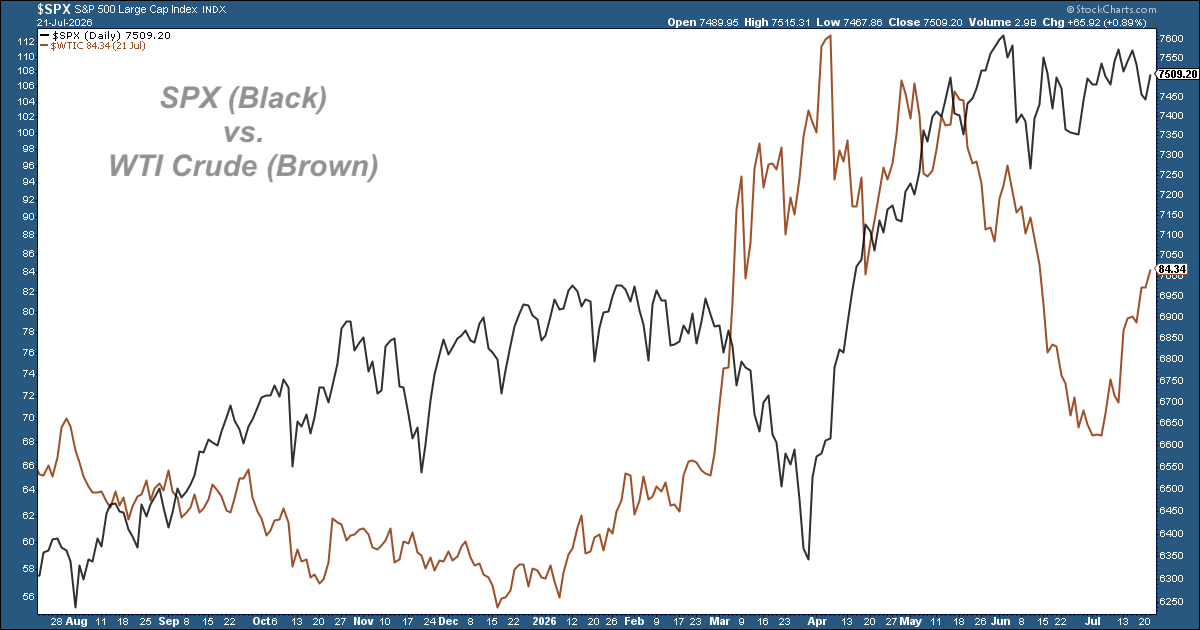
Brent is at a six week high above $93 a barrel and WTI has pushed past $88, both up roughly 20% since the Iran war reignited in July. $100 on WTI is the level that matters to me. Below it, this stays a geopolitical premium that can fade on any de-escalation headline.
Above it, oil starts to bite into consumer spending and complicates every inflation conversation the Fed is having. EIA crude inventory data is due later today, and given this week’s tanker U-turns and Red Sea threats, a bigger than expected draw would only add fuel to the move higher.
Trump also announced a 100% tariff on generic drug imports starting August 2028, doubling to 200% a year after that, giving manufacturers two years to move production onshore. India supplies more of America’s generic drugs than anywhere else, and pharmaceuticals are among its top three exports to the US, worth $10.5 billion last year. The Nifty Pharma index fell as much as 1.9% on the news, with Sun Pharma down in step.
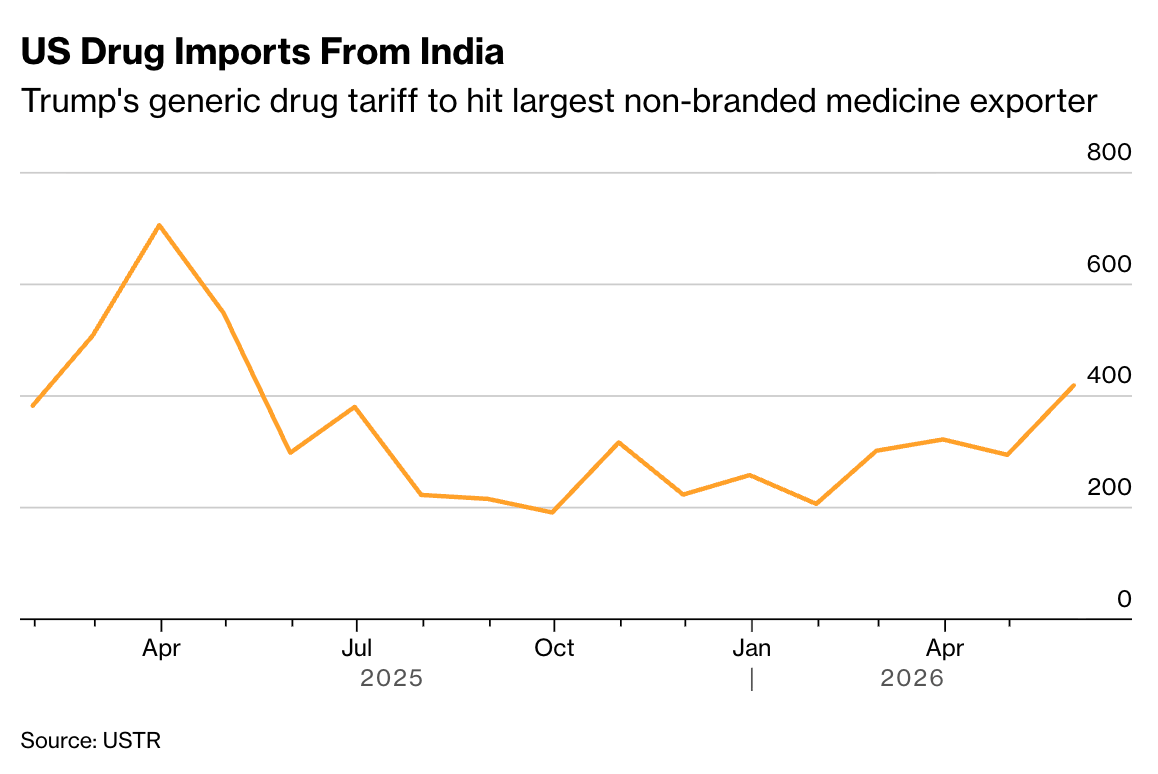
I doubt reshoring lowers prices. Generic makers compete on thin margins, and pushing production into a higher cost country is more likely to squeeze supply than cut costs. Expect higher prices on the same drugs Americans already rely on, not lower ones.
Chart of the Day
The chart to watch today is oil, not equities. WTI is closing in on $100 a barrel for the first time since the Iran war began, and that threshold is doing a lot of work in my head this morning. Below it, this stays a fadeable geopolitical premium. Above it, oil starts showing up in every retailer and airline earnings call this year, and I would treat a break above $100 as the signal to start trimming cyclical longs priced for oil staying range bound.
Calendars
Today is a loaded calendar day even before Google and Tesla report tonight. EIA crude inventories are due later, right as oil tests its highest levels of the war.
Earnings Previews: Google, Tesla and Texas Instruments
Alphabet (GOOGL) Q2 Outlook: AI Capex vs. Cloud Scaling
Investors want proof that heavy server spending is converting into cloud profit, with Search margins expected to keep funding the data center buildout.
Financials: consensus revenue near $118.9B (up ~23% YoY), operating income of $41.6B to $42.5B, and EPS of $2.88; full year capex guidance holds at $180B to $190B, with Q2 outlays of $45B to $50B following recent US debt and equity raises.
Growth drivers: cloud growth above 70% would beat the 64% consensus, with backlog watched for expansion from $460B toward $500B; Search revenue is targeted at 17% growth on paid click volume, while YouTube ad revenue is expected up 10% to 11%.
The quarter’s verdict rests on whether AI spending is generating momentum rather than draining cash. Watch also for updates on Gemini adoption, Ironwood TPU traction, and the new Antigravity agentic platform.
Tesla (TSLA) Q2 Check-In: Deliveries vs. Margin Pressure
Tesla heads into Q2 having delivered a surprising 480,000 units, but focus has shifted from volume to profitability as pricing cuts and financing promotions pressure auto margins.
Financials: full year revenue tracked at $104B to $105B and consensus EPS of $0.47 (bear cases as low as $0.36 on margin compression), with auto gross margin seen slipping from 19.2% to roughly 18.0% on US promotional financing, warranty unwinds, and lower upfront FSD pricing.
Operations: Q2 deliveries of 480,000 outpaced production of 452,000 by 30,000 units, with investors wanting evidence of real demand rather than European pull-forward; energy storage deployments were up 40.6% YoY to 13,500 MWh, and watch for updates on Robotaxi, Cybercab, and Optimus Gen 3 timelines.
The key question is whether auto margins have bottomed. Clear progress on autonomy and potential SpaceX synergies would reassure the market that Tesla can fund its broader AI ambitions.
Texas Instruments (TXN) Q2 Preview: Testing the Analog Recovery
TXN enters Q2 as the premier pure play on an analog cyclical recovery, after industrial revenue jumped over 20% sequentially in Q1. With AI data center demand layering onto core industrial and automotive exposure (~69% of sales), the question now is how fast margins expand and whether the recovery broadens.
Financials: guidance at $5.20B (~8% sequential growth) and $1.91 EPS at midpoint, with a beat needing revenue above $5.24B and EPS above $1.95 given valuation near 30x 2026 earnings; gross margin is targeted at 59.4%, up from 58.0% in Q1, with 60.0% signaling faster cost leverage from 300mm wafer fabs.
End markets and inventory: industrial needs continued sequential momentum while automotive, flat in Q1, needs to inflect back to growth; days of inventory are targeted to fall from 209 toward 195 to 200 days, confirming consumption is outpacing production.
The setup hinges on proving TXN’s margin lag versus peers is a temporary 2 to 4 quarter delay, not structural. With AI server racks pulling 3x to 5x more analog content ($600 to $1,000 per server), a strong print would validate TXN’s combined industrial recovery and AI power management story.
Market Prep
Tuesday was a genuine risk-on session. The S&P added 89 basis points to close at 7,509, the Nasdaq 100 jumped 193 basis points to 29,155, and the Russell 2000 gained 138 basis points. Momentum had its best single day since COVID, up 9.4%, led by semis and AI names, while the VIX dropped nearly 9 points to 17.02.
Volume told a different story though, just 15.9 billion shares against a year-to-date average near 19.5 billion. That is a positioning unwind, not a wave of new buying, and it matters for how much further this bounce can run without fresh money behind it.
Options flow backs that up. Clients were re-shorting the AI losers basket against the broad AI basket, betting the relief rally in beaten-down software and AI-adjacent names fades from here, while also adding DRAM downside. The SPX options market is pricing only a 0.77% implied move through Thursday’s close, which is a low bar heading into two mega cap prints tonight.
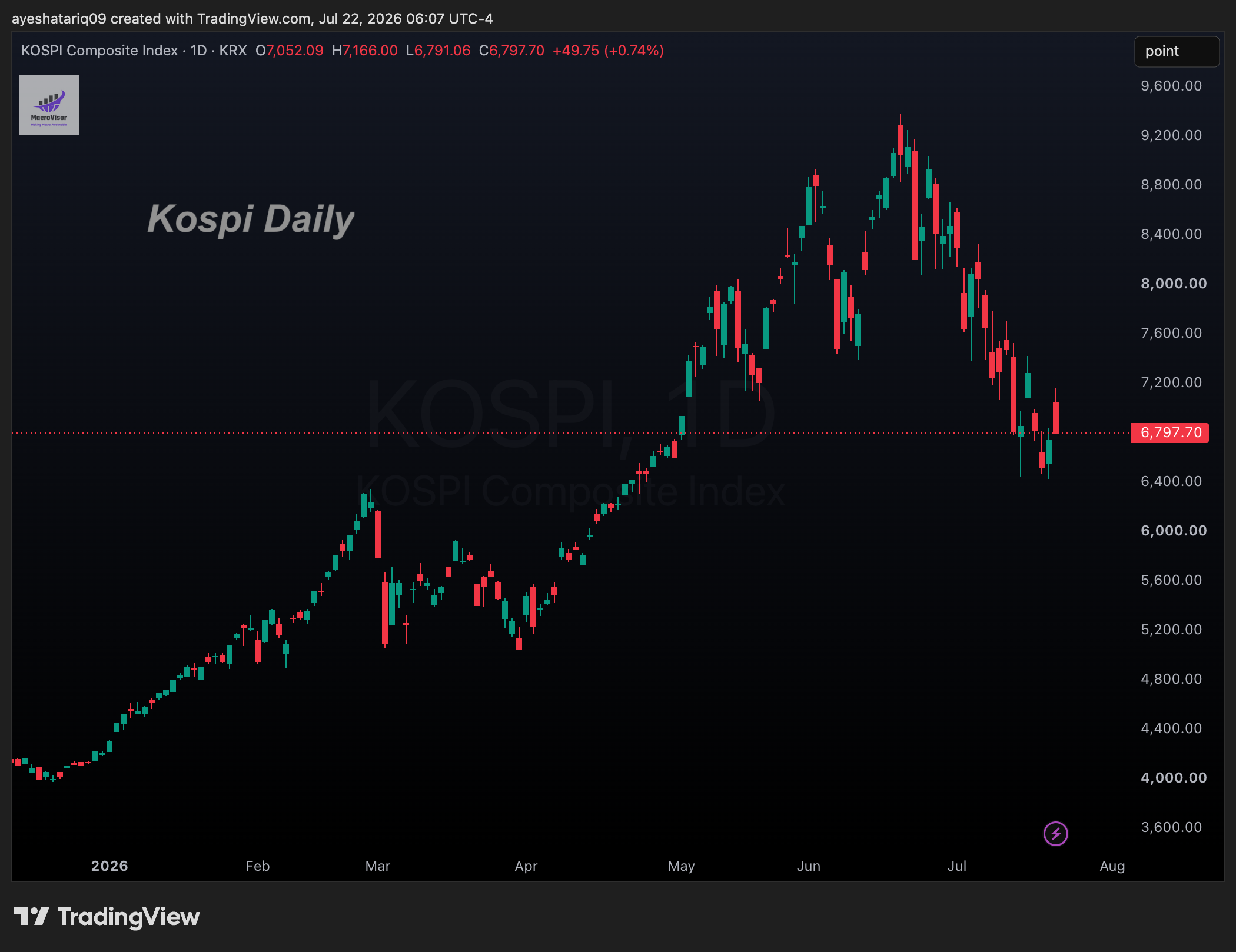
Asia set the tone overnight. The Kospi spiked as much as 6% at the open before settling near +4%, even after SK Hynix denied talks to buy Intel’s Ohio plant. It has since given up much of its gains. The Nikkei added about 1%, while Shanghai stayed roughly flat as Beijing manages liquidity ahead of the large CMXT IPO next week.
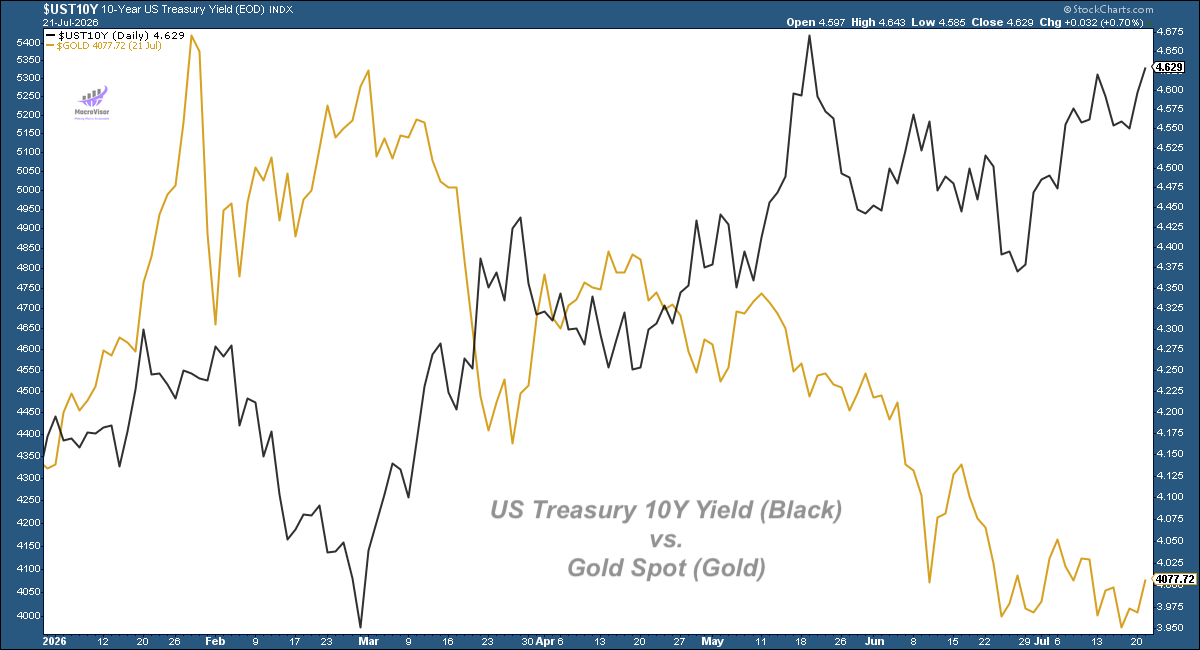
The stranger story is in metals. Gold above $4,130 and silver near $60 an ounce are both still climbing despite higher oil, higher bond yields, and a firmer dollar, a correlation break that has held since the Iran war began in February. When gold ignores higher real rates like this, it usually means the market is pricing tail risk, not just inflation, and I would not fight that signal here.
One liquidity date worth circling is August 4, when SpaceX reports its debut public quarterly earnings and triggers the first major insider lockup expiry, freeing up roughly 20% of shares for potential sale.
Three things stand out to me today. Google and Tesla report after the close, where the buyside bogey on Google’s cloud growth sits at 70 to 75%, well above the Street’s 64% estimate. Anything short of a 2027 capex number near $325 to $350 billion risks a sell-the-news reaction even if the headline numbers beat.